Plain-English explanations for every event
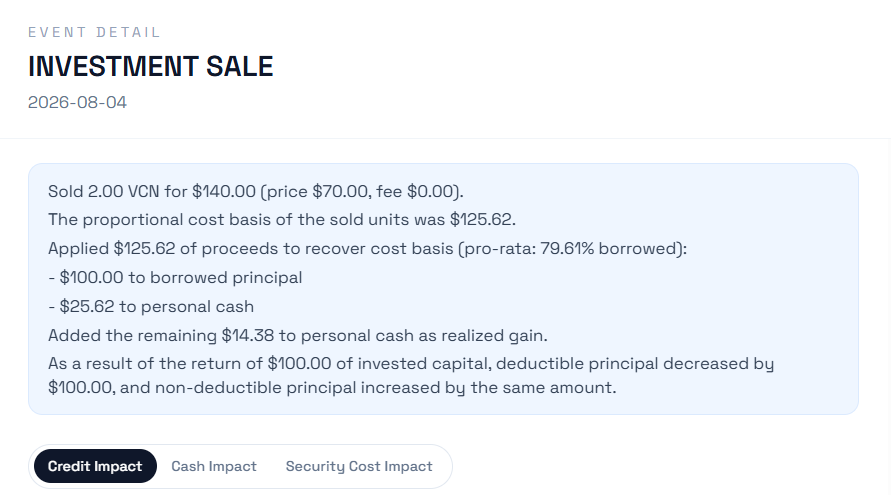
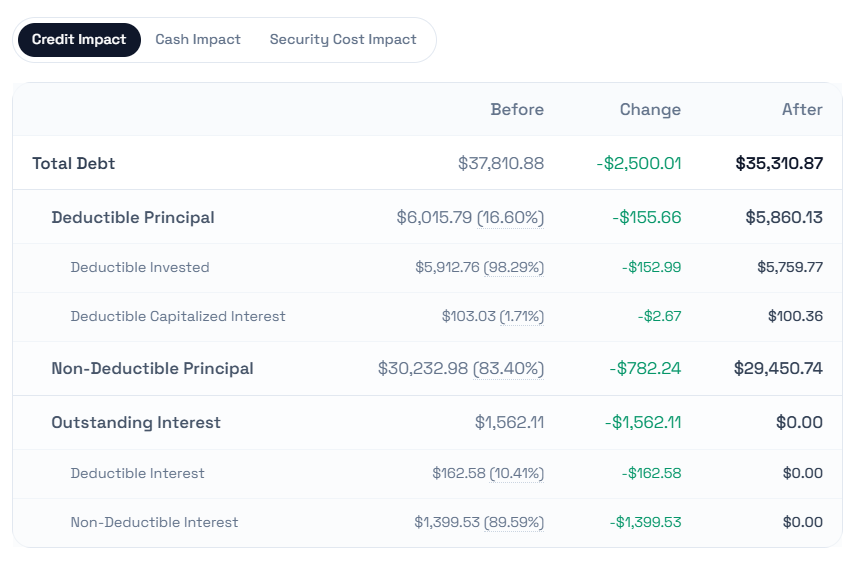
Open any event — a sale, a distribution, a payment — and see exactly what changed, why it changed, and how the deductible split moved. No formulas to reverse-engineer.
How events work →Leveraged investing works — until tax season asks how much of your interest is deductible and you're guessing. Every distribution, every repayment, every rate change shifts the split. Whether you're running the Smith Manoeuvre or just starting to invest with borrowed funds, the math compounds faster than you'd think.
Ded. Interest YTD
$8,412
Total Debt
$425,000
Brokerage Cash
$3,870
Debt Structure
Holdings Capital
Yearly Interest & Debt
| Year | Deductible | Total Int. | EOY Debt |
|---|---|---|---|
| 2026 | $8,412 | $8,860 | $425,000 |
| 2025 | $24,180 | $25,100 | $418,600 |
| 2024 | $21,350 | $22,410 | $392,000 |
Brokerage Cash
The real complexity starts after — when you sell holdings, receive distributions with hidden Return of Capital, or use the same credit line for life.
Selling holdings
A position that started with borrowed money doesn't stay pure. Reinvested distributions add personal capital over time. When you sell, tracking shows what part of the proceeds must go back to debt principal, and what you can keep.
How sale proceeds are split →

Return of capital
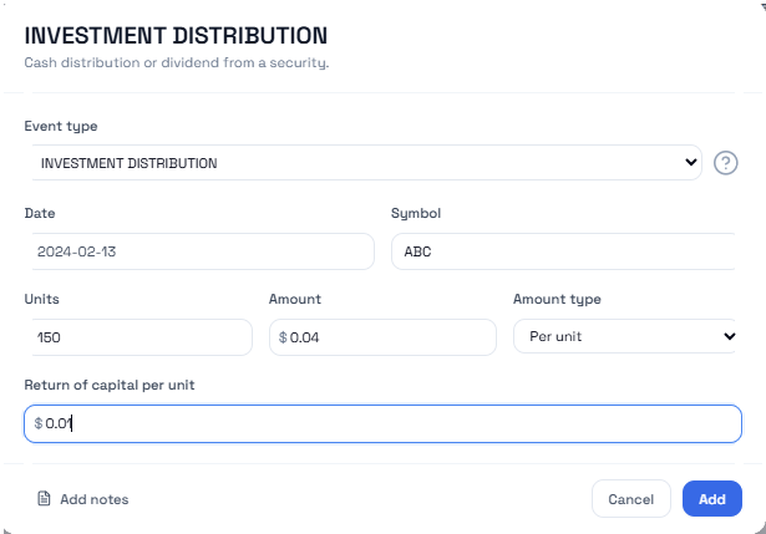
You received distributions, used the cash, and moved on. Months later, the T3 says part was Return of Capital. Tracking shows what should have reduced debt, how long it didn't, and what correction is needed.
How RoC affects deductibility →Mixed HELOC use
Once personal spending touches the same HELOC, the line is no longer clean. CRA requires proportional repayment — you can't target the personal portion first. Tracking shows the exact split and how each payment shifts future deductibility.
The proportional repayment rule →
Open any event — a sale, a distribution, a payment — and see exactly what changed, why it changed, and how the deductible split moved. No formulas to reverse-engineer.
How events work →Every calculation follows CRA Folio S3-F6-C1 tracing rules. Proportional allocation, cash-basis timing, documented methodology — not informal assumptions reconstructed at tax time.
CRA rules applied →Forgot to record something? Add it with the correct date — the app recomputes all balances from scratch. Edit or delete past events and corrections cascade forward automatically.
Getting started →Instead of importing bank statements or maintaining spreadsheet formulas, you record financial events and the app handles the rest.
Borrowed money, bought ETFs, received a distribution, made a payment — enter the event with a date and amount.
The app updates all balances, calculates the deductible split, and generates a plain-English explanation.
Your total deductible interest is always current — no year-end scramble, no reconstructing from bank statements.
Enter your borrowing terms and tax bracket. The table shows your profit at different market returns — portfolio gain minus after-tax borrowing cost. Taxes on investment income are not included.
Annual interest
$6,000
After-tax cost
$3,300
Effective rate: 3.30%
| Market return | Portfolio gain | Annual profit |
|---|---|---|
| breakeven3.30% | $3,300 | $0 |
| 6% | $6,000 | +$2,700 |
| 9% | $9,000 | +$5,700 |
| 12% | $12,000 | +$8,700 |
| 15% | $15,000 | +$11,700 |
This assumes the full deduction applies at your marginal rate. If your deductible interest exceeds the portion of your income in the top bracket, part of the saving falls to a lower rate. Taxes on investment income are not included. This calculator is educational, not tax advice.
No. The app is software for record-keeping and consistent methodology. It does not provide legal or tax advice. Always consult a qualified tax professional for your specific situation.
Built by a Canadian leveraged investor who needed this tool and couldn't find it.